Serial 2 S Complementer Shift Register

Design a serial 2’s complementer with a shift register and a flip-flop. The binary number is shifted out from one end of the shift register, and it’s 2’s complement shifted into the other end. Subscribe to view the full document. Apr 29, 2010 - Hey guys, so the question reads: It is known that the 2's complement of a binary. Design a serial 2's complementer using this procedure. The circuit needs a shift register to store the binary number and an SR flip flop to be set.
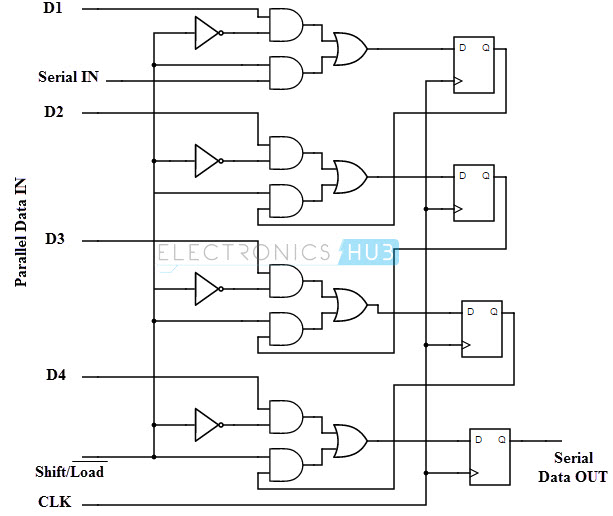
Thanks for your kind reply See I have followed you and understood your line 39 to 51 is printable characters. In my case I have attached 74HC165 TO GET PARALLEL DISPLAY DATA FROM AN INSTRUMENT TO CONVERT IT INTO SERIAL AND THEREAFTER SERIAL DATA INPUT TO ARDUINO FOR DISPLAYING THE OBJECT OF THE INSTRUMENT INTO THE DISPLAY OF ARDUINO. AND THERE IS MY PROBLEM IN SPTE OF GETTING THE “INSTRUMENTAL DISPLAY OBJECT” i AM GETTING THE “011000” VALUE ACCORDING TO YOURS. WOULD YOU PLEASE BE ABLE TO GUIDE ME TO CONVERT THIS “011000” DATA TO ACTUAL DISPLAYING OBJECT? THANKS FOR YOUR INFORMATION: THE ACTUAL DISPLAY OF THIS INSTRUMENT HAS BEEN DISCONTINUED AND THEREFORE i WANT TO TAKE THE DISPLAY DATA OF THE INSTRUMENT INTO ARDUINO THROUGH ON ITS LCD. Stalingrad. From my understanding, you have the buttons well connected to the shift register and the output of shift register is also connected to the Arduino.
If you are using the same display (16×2 HD44780 LCD), then the code above should have worked for you. If you are using other display, you may need to change to code for the display. Another thing that you can try is, first make sure you read what is exactly send from the shift register. Change the code to display it using your serial monitor. From there, if you able to read the correct input from your buttons, then its just the display code you need to work on. Hope this helps.
Arch #11 Computer Architecture Start Lecture #11 Homework: Read 3.1-3-4 3.1: Introduction I have nothing to add. 3.2: Signed and Unsigned Numbers MIPS uses 2s complement (just like 8086) To form the 2s complement (of 0000 1111 0000 1010 0000 0000 1111 1100) • Take the 1s complement. • That is, complement each bit (1111 0000 1111 0101 1111 1111 0000 0011) • Then add 1 (1111 0000 1111 0101 1111 1111 0000 0100) Need comparisons for signed and unsigned. • For signed a leading 1 is smaller (negative) than a leading 0 • For unsigned a leading 1 is larger than a leading 0 Comments on Two's Complement You could easily ask what does this funny notation have to do with negative numbers. Let me make a few comments.
• What does minus 1 mean? Ans: It is the unique number that, when added to 1, gives zero. • The binary number 1111.1111 has this property (using regular n-bit addition and discarding the carry-out) so we do seem to have -1 correct.
• Just as n+1 (for n≥0) is defined as the successor of n, -(n+1) is the number that has -n as successor. That is we need to show that TwosComp(n+1) + 1 = TwosComp(n). • This would follow if we coud show OnesComp(n+1) + 1 = OnesComp(n), i.e, (n+1)' + 1 = n'. Kak uznatj nomer podshipnika po diametru vala. • Let n be even, n = *0, * arbitrary. • Write n', n+1 and (n+1)' and see that it works.
• Let n be odd, n = *01 s1, where 1 s just means a bunch of ones. • Again it works. • So for example TwosComp(6)+1=TwosComp(5) and hence TwosComp(6)+6=zero, so it really is -6. Sltu and sltiu Like slt and slti but the comparison is unsigned. Homework: 3.1-3.6 3.3: Addition and subtraction To add two (signed) numbers just add them.
That is, don't treat the sign bit special. To subtract A-B, just take the 2s complement of B and add. An overflow occurs when the result of an operation cannot be represented with the available hardware. For MIPS this means when the result does not fit in a 32-bit word. • We have 31 bits plus a sign bit. • The result would definitely fit in 33 bits (32 plus sign) • The hardware simply discards the carry out of the top (sign) bit • This is not wrong--consider -1 + -1 11 (32 ones is -1) + 11 ---------------------------------- 110 Now discard the carry out 10 this is -2 • The bottom 31 bits are always correct.
Overflow occurs when the 32 (sign) bit is set to a value and not the sign. • Here are the conditions for overflow Operation Operand A Operand B Result A+B ≥ 0 ≥ 0 64 multiplier. What about the control?